Monochrome Drawing Materials preferably in Black/White and Grey Such as:
- Jumbo Graphite sticks
- Eraser
- Sketchbook
- Stool to sit on if needed
Monochrome Drawing Materials preferably in Black/White and Grey Such as:
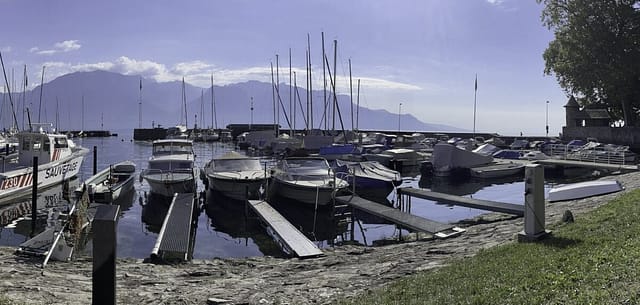
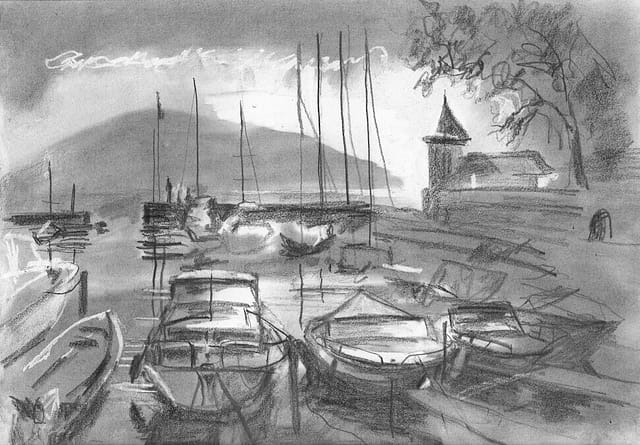
Simplify what you see. Focus on the main elements: those aspects that you want your later painting to be about. Do not include unnecessary objects and elements just because they “were there.” We call that those objects that detract from the scene clutter. Compare the panorama photograph on the left to the drawing on the right. They both depict the same subject but the drawing contains far fewer boats. I only included as many boats as conveyed the right atmosphere and the theme of an intimate marina. All other boats are clutter.
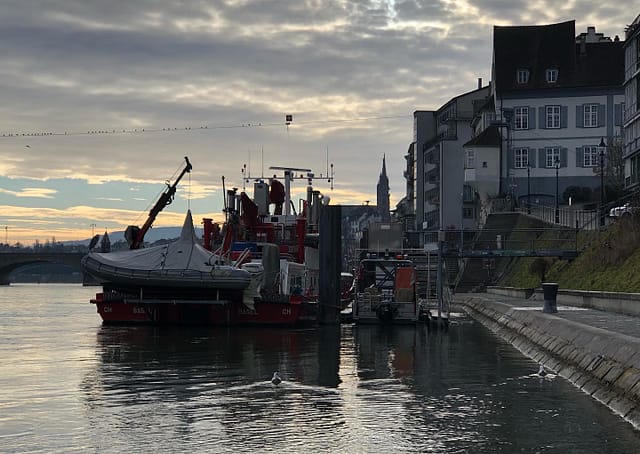
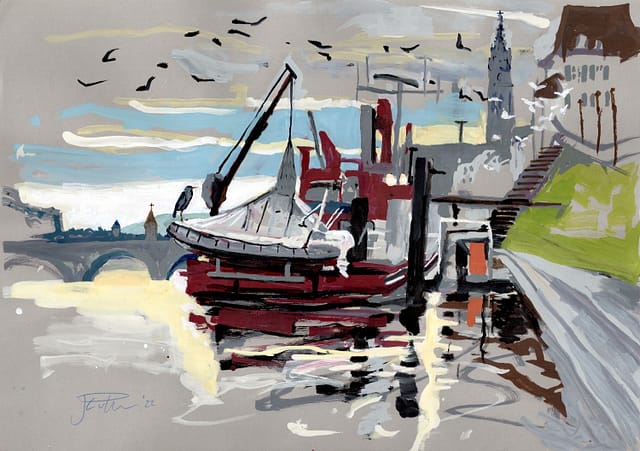
The interesting tangle of metal rods and beams is what drew me to the fireboat as a subject. However, looking at the photograph there is too much of it and the shapes and sizes are too similar. Besides decluttering, I also increased the variety of those shapes that I included. I enlarged the crane and made some of the beams bigger or smaller so that they all stand out as different forms. Similarly, I enlarged the church and eliminated some uninteresting looking buildings. Variety is interesting, repetition is not.
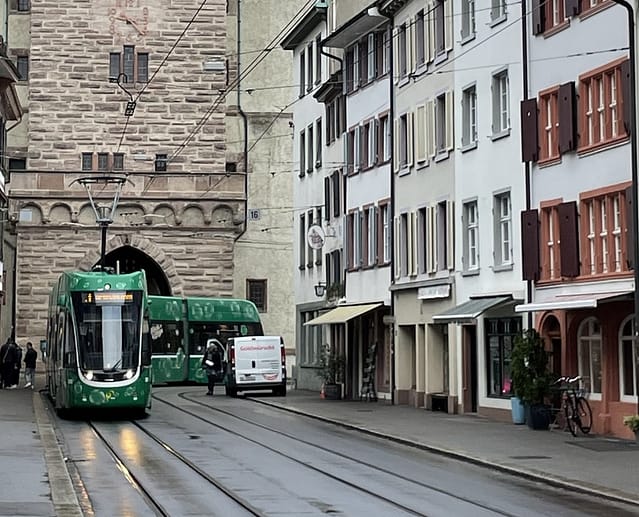

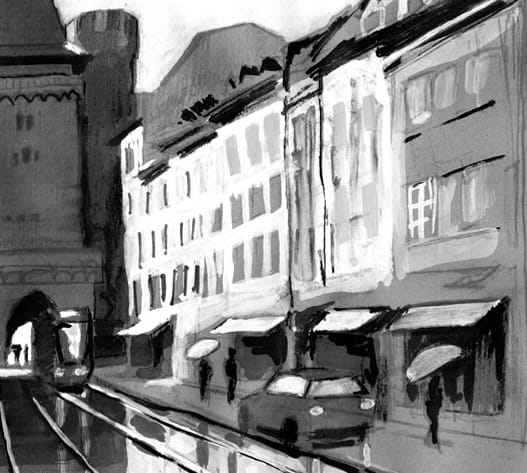
Look at how I have simplified the sunscreens and the walls with windows on the right in the painting. Whereas the reference photograph shows a plentitude of forms the painting only depicts the most important ones, as simple shapes. I have also connected these shapes and depicted them in a unified single color: the sunscreens and the walls are the same light yellowish color, depicting the reflection of light on the surface. As you can see in the value study on the right I prepared this simplification in advance. It can be hard to know what to simplify during your painting. Therefore plan the simplification of shapes in advance. As you can see I even simplified colors and tones more in the painting than in the value study. Try to never slavishly copy. Look for further opportunities to simplify forms throughout the process.
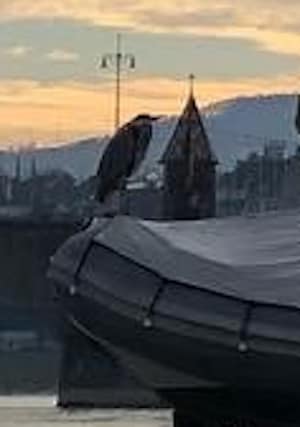
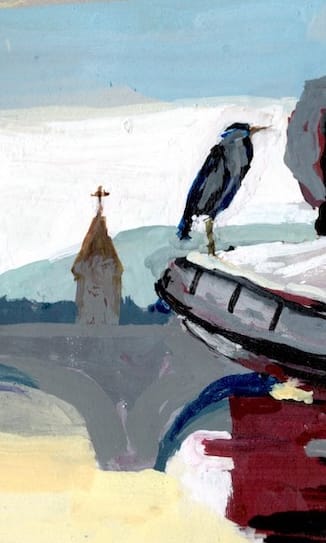
An important element of composition is to create space by overlaps. When two forms partially overlap, the eye will conclude that the overlapping form is closer and the other farther away. In the photo on the left the heron and the turret overlap the mountain in the background. This is a good opportunity to suggest space. However, there is a problem with the placement of the heron that I had to fix in the drawing.
Notice that in the photograph the heron is hardly visible because the top of his head is almost on the same level as the mountain slope. This is alignment of two different forms in the flat plane is called a “tangent.” I moved the herron up in the drawing so that he overlaps the light sky.
I have a simple rule for composition:
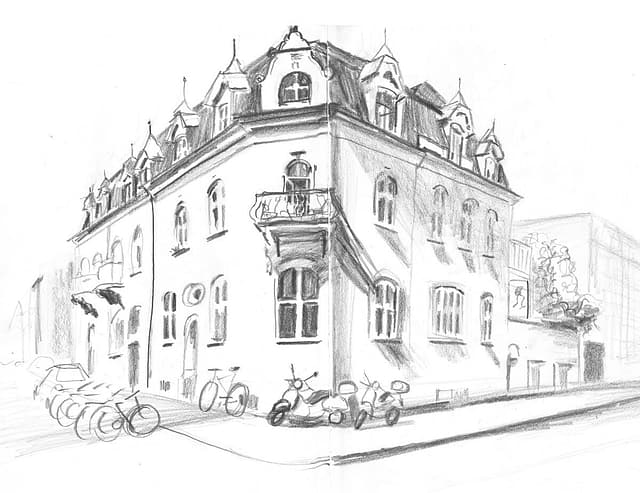
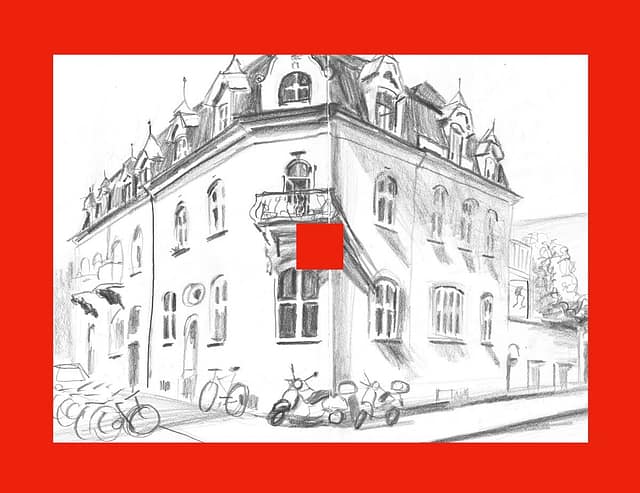
Look at the drawing on the left. This is a central composition. The main subject is the red Vespa scooter. Which I placed on the central vertical axis of the composition to give it a lot of attention. I made sure, however, not to place it in the mathematical center of the paper, but rather much below it. The white building with its large cast iron balcony is a secondary point of interest that I wish to harmonize with the Vespa. Again, I made sure that the balcony, while on the central vertical axis is not in the exact center of the page, but a little bit above it.
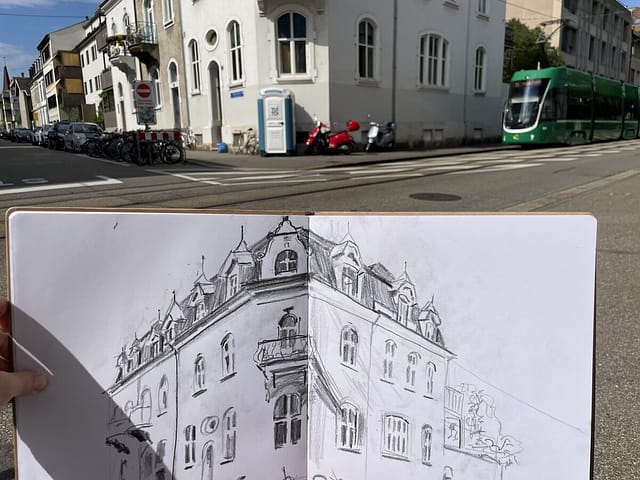
The other part of the red zone is the margin. Here too we want no important elements. In this drawing I left the margin almost empty. If you compare the scanned and cleaned-up drawing on the left with my sketchbook in the photograph on the right, I got in trouble with the top of the front building. The dormer there hits the edge of the paper and is way too much into the margin red zone. If I cannot make a composition work 100% outside, I clean up the drawing at home, I make little changes before I transfer it to the watercolor paper. In this case it is just a matter of fixing the width of the top margin.
Here you can compare my view with the sketch paper. The vertical fold of the sketchbook is helpful for me for laying out compositions. As you see the red Vespa was on the day that I visited this spot not parked in the center of the building because the porter potty had stolen its regular place. Never copy exactly what you see. I eliminated the disfiguring structure and moved the Vespa to its rightful place right in front of the building.